“Music is the shorthand of emotion. Emotions, which let themselves be described in words with such difficulty, are directly conveyed to man in music, and in that is its power and significance.”
(Tolstoy, 1991)
Introduction
Film Composers reflect the emotional dimensions in the films’ story without drawing attention to their music. Film music is specifically tailored to picture and sound and therefore must work alongside both to fully connect with the story emotionally and technically. In this research I will attempt a subtle synthesis of film music and sound recording techniques to tap into the evocative power of sound used in documentary film, as James Wierzbicki articulates, ‘every sound has meaning…The real world teems with sounds that have meaning in and of themselves and at the same time potentially have meaning as elements in a shared or private semiotic system’ (2016, p.153). There are several compositional techniques film composers use in their creative process such as the choice of instrumentation. The instrument palette of a film score is extremely important as it ‘can fundamentally change the reception of the unfolding images…an audience can be compelled to focus on one character or emotion in particular’ (Rogers, 2014, p.9).
Another technique to note is a recording technique. Film scores are typically recorded in a soundproof studio, however some film composers, like Hildur Guonadóttir, have experimented with various recording locations for more emotional impact in their film scores (Roberts, 2019). Film music is often non-diegetic and its goal is to evoke emotion without drawing attention to itself; in Holly Rogers words to ‘lesson our awareness of the technological construct that unfolds before our eyes’ (2014, p.7). This is achieved by first causing the event of initial association and subconscious reaction that then turns into emotion to support the storytelling.
This subconscious reaction can be explored through affect theory, which Brian Massumi initially describes as ‘the simultaneous participation of the virtual in the actual and the actual in the virtual, as one arises from and returns to the other’ (2002, p.96) He later states that ‘the virtual’ as linked to the human perception of external stimuli which based on the level of intensity/effect is a non-conscious, never-to-conscious autonomic remainder of bodily reactions to external stimuli (p.25). This evocative power also lies in the sound design, ‘both sound designers and composers work in organising, or controlling sound for the purpose of affecting the audience in an emotional manner’ (Reizes, 2013, para.6). Film music and sound design both hold significant power in the communication of emotions in film, so it stands to reason that combining these two crafts could produce a more powerful affect.
I will attempt a subtle synthesis of techniques purely intended to tap into the evocative power of the sound recording used in documentary film. The project that inspired this idea was a short documentary I composed for, 1 in 1000 (2022). It was a documentary proof of concept designed to test different techniques in preparation for the documentary students capstone films. I proposed that music and sound design work together to form one continuous audio track throughout the film. As the documentary was centred on the continuous catastrophic floods in Camden, NSW 2022, the natural sound of the water held significant emotionally evocative power in its familiarity and heaviness. The role of a film composer is to enhance the emotions in the films’ story, therefore the music might gain more emotional power by tapping into the emotionally evocative sound of the water. This idea formed into a research topic led by the question:
How can the synthesis of techniques in film music & sound recording be employed for affective meaning in screen storytelling?
This research is based on a synthesis of techniques that have already been used in the industry, such as choice of instrumentation and recording environments. There are a variety of techniques composers and sound designers can use to combine their skills for the betterment of the project. Screen examples such as August Rush (2007), The Pacific: In The Wake of Captain Cook with Sam Neill (2018)and Atonement (2007)use elements of sound design as instrumentation in the music, while Chernobyl (2019) demonstrates how varied recording environments can affectively impact the film score. Both techniques were executed with skill and expertise, but still allow room for experimentation.
The documentary I will use as my main contributor to this research is River Town People. This film tells the story of a family struggling to rebuild their home and their lives after the catastrophic and devastating 2022 Lismore floods while dealing with the confusion and deception of the buy back scheme. This research will experiment with instrumentation and recording environmentsto synthesise techniques in film music and sound recording to enhance affective meaning in storytelling. The success will be based on my own reflection as composer, as well as feedback from the rest of the River Town People post-production team: director, Michelle Kaldy, sound designer, Sharay Armfield and editor Chimene Khoo.
Due to the emotions attached to the damage of the 2022 Lismore floods in the documentary, River Town People, there was an opportunity to use the sound of rushing water as an instrument in the score. This choice was based on the emotional significance the element of water holds in the story. After discussions with the director, sound designer and editor, it was decided that in some of the scenes where the main participant, Lucy, was describing the damage caused by the floods, there was space to draw on the heaviness of that sound effect, giving the audience a glimpse into the mind of Lucy and what she lived through. In light of the techniques being experimented within this research, sound recording is a more precise term as it specifically relates to natural recorded sounds involvement with music and ability to be synthesised.
This exegesis will answer my research question through the analysis of case studies, journal articles and books related to the synthesis of techniques in film music and sound recording. The examination and analysis of sources will provide a context to position this research. This is creative practice research, which means my primary research relates to my work as a composer. This will be demonstrated through a variety of methods experimenting with the previously mentioned film music and sound recording techniques. This exegesis will discuss the creative processes used in synthesising techniques while including examples of results and feedback from collaborators.
This exegesis is presented in linear form.
Please scroll down to read.
Source Review
The Power and Significance of Film Music & Sound Recording
Music and sound hold significant power in enhancing affective meaning in screen storytelling. ‘Music can hold things together and tell the story…it can help to turn each visual representation into a highly personal vision’ (Rogers, 2014, p.9), more specifically, music creates atmosphere, highlights the psychological states of characters; provides neutral background filler, builds a sense of continuity and sustains tension before rounding it off with a sense of pleasure (Cooke, 2010). It brings out the various connections and divergent points of view (Burt, 1994).
On the other side of post production ‘sound design is how filmmakers flesh out the aural world of the film to enhance the mood, atmosphere and/or tone’ (Kench, 2020, para. 3). Individually these two creative practices have the ability to enhance mood, create atmosphere and greatly influence storytelling in a film. Because both music and sound design are responsible for the entire audio track of a film, they must work hand in hand to influence the story, this process includes each craft working in and around non-diegetic music, dialogue and sound effects. The score of a film is tailored specifically for what is happening in the film on screen (DeGuzman, 2021, para. 5), much like the sound design must be synced with the visual of the film, the music must come in at very specific points in order to have the most affective impact. ‘Historical referents and rhythmic persuasion of music make the use of creative sound an extraordinarily compelling device’ (Rogers, 2014, p.3). This makes the relationship between both crafts incredibly important to the filmmaking process as they must work with each other, the picture and the narrative.
Affect Theory
To fully comprehend what power sound design and music have in the making of a film, I will briefly touch on affect theory. Affect is the subconscious reaction one experiences before it becomes emotion. Once the feeling becomes conscious, it turns into emotion and the body can identify what you’re feeling. Affect is making you feel something without realising you’re feeling it (Massumi, 2002 p.35). In the encyclopaedia Music in the Social and Behavioural Sciences it defines affect theory as this:
Affect is not a thing, it is an event, and its active qualities and essential non-thing-ness constitute its active, vital identity…it arises from encounters between bodies, as the two-way relationship to “affect and to be affected”…A theory of affect for music involves theorizing intensity, passage, motion, in-between-ness.
(Thompson, 2014, p.25)
Therefore, as music is mainly used to evoke an emotional connection between the audience and the story, it first creates the ‘event’ that causes humans to subconsciously react to the music before it becomes an emotion. Film composers have used various techniques to facilitate this event. Through their experiments, industry professionals and scholars have identified the reason music (and consequently, sound recording) can be so successful in evoking emotion. Helen O’Shea diagnoses how music and sound gains its evocative nature in Reel Tracks: Australian feature film music and cultural identities. O’Shea states that sound and music have to be first associated with a certain event or emotion in order to gain its evocative standing (2005, pp.38-39).
As previously stated, music and sound are equally responsible for establishing the atmosphere. To make a story believable and relatable, there are certain elements in the sound and music that are needed to set the scene. This is where affect theory explains the process of what happens. When a person is exposed to the sounds of birds chirping and leaves blowing in the wind they might assume the location of the scene is in a park or some kind of natural setting they are familiar with. The person does not consciously decide what setting makes the most sense, but the interaction between the person and the scene triggers the event that allows the person’s past experiences and association to specific sounds to determine where the scene is taking place. In creating this event, sound holds the power to evoke emotion and therefore enhance affective meaning within the story. This process repeats when music is introduced.
Where, as mentioned in the introduction, most film music is non-diegetic, its unrecognisable state, it also holds the power to evoke emotion by causing the event of initial association and subconscious reaction that then turns into emotion to support the storytelling. The psychological response must come first, ‘sometimes, the score itself can be a point of response for an audience, similar to a sound effect or sound design. Segments of a film score may aim to elicit a psychological response from an audience…’ (DeGuzman, 2021, para.21). DeGuzman then references one of the best known examples for the power of music, Alfred Hitchcock’s Psycho (1960).He discusses the music’s collaboration between visuals and music, the ‘music addresses a sense that the visuals of a film cannot. When both work together to elicit the same psychological response of fear, the result is extremely effective’ (2021, p.23). DeGuzman reinforced this by using Avengers: Endgame (2019) as an example of how a film score can set the tone of the film and accentuates the emotions of a scene. ‘Note how as the tone of the scene transitions from dread to hope, so does the score’ (2021, para.18).
Sound Techniques Synthesised in Music
After diving into the psychological and emotional power of music and sound design, it is more feasible to suggest that combining these two crafts could further support the storytelling of a film. To begin investigating how these two crafts might be integrated, it is important to look at what techniques have already been used and proven successful. The Palgrave Handbook of Sound Design and Music in Screen Media: integrated soundtracks is a fantastic place to start as it investigates the disintegration of boundaries between sound design and score while addressing the collaborative nature of screen media and how that affects this process. In “Intertwining Music and Sound in Film” Martine Huvenne discusses the art of making a sound appear like it’s part of the score. As an example, she uses the opening scene of Atonement (2007). Referring to the sound of the typewriter in this opening scene, she describes,
a camera movement takes us towards the source of the sound. Till now the sound is related to what happens within the diegesis. But in a subsequent scene, Briony runs through the house to show her mother her finished play. In this scene, the sound of the typewriter has become a percussive sound that is fully integrated into the music composed by Dario Marianelli…Integrated in the musical composition, the sound of the typewriting conforms to the pace and metrical rhythm of the music. The source of the sound is still the same, but the rhythm and the dynamics of Briony’s gestures of typewriting are not audible anymore in the new musical context.
(2009, p.124)
This suggests that by adding a sense of rhythm, dynamics and melody to a natural/familiar and possibly previously diegetic sound, that sound can become subtly integrated into the score and blur the lines between sound design and music without distracting the audience from the story.
Clip from Atonement (2007)
Another composer who successfully integrated sound design and music is Mark Mancina in his film score for August Rush (2007). The only difference in this film is the nature of the story. The main protagonist, August, is a young composer prodigy and has the ability to hear music in his surroundings. Music was a very obvious part of this film and therefore Mark Mancina did not have to worry about making the integration subtle, as it was expected and occasionally crossed the line between diegetic and non-diegetic because it worked with the story.
Clip from August Rush (2007)
Music Techniques Synthesised in Sound
There are several films that have already experimented with synthesising music techniques in sound recording, for example Chernobyl (2019) composer Hildur Guonadóttir wrote a film score in which every sound was captured from a now-decommissioned power plant in Lithuania where the series was filmed. In an interview on Score: The Podcast, Guonadóttir said: “It’s such a complicated story to tell. How does that sound? Like what does a catastrophe really feel like and how does it sound?” (Roberts, 2019), Guonadóttir used something emotionally connected to the story and created the music from the sound recording. Film composers have continued to experiment with synthesising techniques, however when it comes to recording music underwater, that has not yet been done in a film context.
Composer Michel Redolfi has written an album of music that synthetically replicates what it would sound like to play music underwater, while Danish band, Aquasonic recorded an album using custom-made underwater instruments. ‘Led by founding members Laila Skovmand and Robert Karlsson, five musicians and singers equipped with custom-made underwater instruments submerged completely in individual tanks. Within their tanks…the artists produce charming and disquieting music and sounds at once’ (Scippa, 2015).
I have carried this initial research and experimentation across into the film music for River Town People, however the experiments I am planning are slightly less radical, definitely less expensive and will hopefully produce similarly affective results.
Methodology
The research and experimentation in the synthesis of techniques in film music and sound recording is reliant on the human experience, therefore this research will take a constructionist approach. This viewpoint values the subjective view of the insider perspective by providing research that is contingent on human practices (Crotty, 1998, p.42). The methodology of this creative practice research can only be defined as practice-led research as it focuses on the result of creative experimentation conducted by myself and other collaborators on the film project. This demonstrates the process of systematically gathering reflections on the process of doing/making in order to contribute knowledge to the practice of doing/making (Barry & Kerrigan, 2018, p.7). The music and sound used in the documentary, River Town People, will be the final result of this research.
Methods
To gain a solid understanding of the current academic research in the domain to form the basis of this research, the methodical process will begin with traditional research methods such as observation and analysis of case studies, textual sources and interviews. After meeting with collaborators attached to the documentary River Town People to discuss what instrument palette and style will best work for the film I will compose ‘temp’ music for the editor, Chimene Khoo, to use in her editing process. This ‘temp’ music will then be used for experimentation in the synthesis of techniques in music and sound. The experiments will take form in two parts: using sound recording techniques in film music and using music techniques in sound recording.
The first experiment will be incorporating elements of natural sound design as instrumentation in the film music. In the second experiment Sharay Armfield and myself (sound designer & composer) will record music underwater. Following these experiments, the results will be used in the film to connect the world of music and sound and demonstrate the synthesis of techniques in both music and sound recording. Along with my own reflection as composer, these results will be presented to the River Town People post-production team, director Michelle Kaldy, sound designer Sharay Armfield, and editor Chimene Khoo. By presenting to these specific heads of department, the feedback can be presented as narrative feedback and technical feedback which will cover the fundamental success of the research.
Theoretical Framework
The theoretical framework I will be basing the reflection of this research on is the Kolb Learning Cycle, in which my creative process can be categorised through Experience, Reflection, Conceptualisation and Testing (Schon, 1987). To further expand on the reflection portion of this cycle, I will show my reflection via the Reflective Practitioner Approach, which is an extension of Schon’s theoretical framework. This approach will reveal the reflection in action, reflection on action and reflection for action, added by John Cowan (1998).
Research
Music for Documentary
In an effort to understand the composing style used for documentary and see if any other composers have used similar methods of synthesising music and sound recording techniques, I reached out to Australian composer Caitlin Yeo. Yeo used natural elements and sounds as instruments in her film score for documentary series The Pacific: In the Wake of Captain Cook with Sam Neill (2018). She generously granted me an interview and during our discussion she not only showed great enthusiasm and support for this research idea but confirmed that the techniques I will experiment with have not been used before in Australian cinema. The interview with Caitlin Yeo as well as information found in the Routledge music and screen media series book Music and Sound in Documentary Film, confirmed the importance in selecting techniques and sounds that hold emotional significance in the story (Rogers, 2014).
Due to the proven success of natural sounds used as instrumentation, this approach will be put into practice as the first synthesised technique in music. For synthesised recording techniques I will use a natural element to affect the entire sound of the music by recording music through a speaker submerged in water. Hopefully this experiment will result in a successful synthesis of techniques in film music and sound recording. Before discussing the specifics of each experiment it is important to note that the experimentation in this research was conducted within the confines of this specific project. Therefore not all variables such as instrumentation, water amount & equipment was experimented with. The research was designed to produce results based on stylistically appropriate music composed for the documentary River Town People.
1 in 1000
As previously mentioned, the project that inspired this research topic was the documentary, 1 in 1000. The director, Michelle Kaldy, knew she wanted to make a documentary centred on how floods affect communities. In the first meeting for 1 in 1000 the sound of roaring water was brought to my attention as something that would be very present in the film. To create the affect ‘event’ (Massumi, 2002) and enhance emotion evoked by this sound, I proposed that we connect music and sound design to form one continuous audio track throughout the film. As creative practitioners begin to push the boundaries of their craft, they must tread carefully as to not overstep and detract from any other crafts. Due to the tight deadline and lack of communication in 1 in 1000, the music shared the same frequency as the sound atmosphere and therefore, in places, got lost underneath the noise. This project was designed to be a learning opportunity; a safe environment to test the boundaries and experiment; as a result the director was pleased with the style of the music composed and decided that would be the style appropriate for her capstone documentary. This project taught me to be aware of frequency clashes between music and sound design when conducting experiments – a problem that can easily be avoided by close communication between collaborators.
Clip from 1 in 1000
The World is a Stage
Not long after 1 in 1000 another opportunity to test the synthesis of techniques presented itself in the form of an audio drama titled The World is a Stage (2022). The screenwriter (acting director) wanted the music and sound to enhance the supernatural base of this story. Sharay Armfield and myself found this the perfect opportunity to experiment connecting music and sound to create the affect event that would enhance the supernatural feel. The key moment we focussed on was when the character walked outside and the increasing tension in the music transformed into a cold wind sound to help communicate the hollow feeling of grief and confusion. The instrument palette I used needed to share qualities with the sound recording of the wind (such as timbre1 and frequency) so the transition could be as smooth as possible. The creative process for this audio drama was very smooth, communication was clear between each collaborator and the result produced was considered a successful synthesis of techniques.
Clip from The World is a Stage
River Town People
As mentioned in the introduction, the documentary I am using as my main contributor to this research is River Town People. While the documentary is not focussed on the flood event itself, it heavily references the devastation brought to the community by the natural disaster. Therefore the music can tap into the evocative power of the waters’ familiarity to create an affect event and enhance the emotion in the narrative.
May 2023 Experiments
As the documentary entered production, the sound designer, director and I had multiple meetings to discuss what techniques would be synthesised. I have used various sound elements in my compositions for their evocative nature and emotional enhancement through the affect event, so the experiment we planned was a synthesis of music techniques in sound recording that would hopefully cause the same affect event. ‘It is not an unfamiliar thing for humans to be underwater’ (Armfield, 2023).
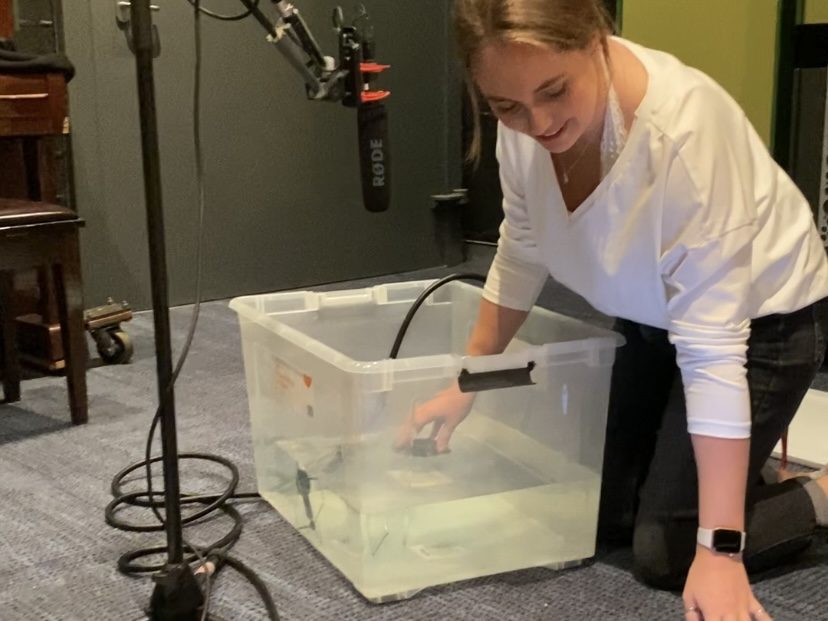
The team decided to record music underwater, drawing on the familiarity of being fully submerged. The music I had written for 1 in 1000 was stylistically appropriate for the experiments, specifically Devastation, so the sound designer and I began our experiments by playing the music through a small Bluetooth speaker in a tub of water. We planned to use a hydrophone, but unfortunately the hydrophone AFTRS2 had available was from the 1970’s and due to its cable damage was useless. However, we managed to test a few techniques with the shotgun microphone, submerging the speaker in the water and recording from outside the water. This experiment took place on the 10th of May in the foley sound recording studio and presented some very interesting results. To test a variety of techniques, we recorded music with the speaker fully submerged at different depths and then with water movement.
Before analysing the results, it is important to mention the limitations of the equipment used. The idea behind the experiment was to begin to see if the water had any effect on the music, that is why the focus of this research is not on the equipment itself and how the music was played and recorded underwater. The sound designer and I thought it best to keep the equipment simple and consistent to achieve clear initial results while leaving the research open for further experimentation. The water movement experiment was not very effective in that it simply added an instrumental layer to the music, which has already been experimented with more successfully in past projects. The experiment of note was the speaker fully submerged recorded with the hydrophone (Underwater Recording).
Figure 1: Christina Bowden recording Devastation underwater
Devastation – Original
Devastation – Underwater Recording
Feedback from Collaborators
In order to ‘test’ if this synthesis of techniques enhanced affective meaning in the documentary, the results were presented to the director, sound designer and editor of the project. Each of these collaborators are responsible for different areas of the filmmaking process and therefore can elicit unique points of view as to how the music narratively and technically affects the story. The director’s opinion is crucial in the film scoring process as they are in charge of the emotional direction of the narrative as well as the technicalities involved. The sound designer can provide feedback on how well the music fits in with the sound design and if the synthesis of techniques worked from a technical standpoint. Finally, the editor who creates the visual rhythm of the film, can see the affect both narratively and technically therefore providing a valuable point of view regarding how the music can benefit the story.
The feedback from all 3 disciplines was very positive, the director was encouraged by the results and believed that on further experimentation this technique can be used to enhance the emotion in the story. The sound designer surprised me in not just providing positive technical feedback, but recognised some of the emotional power this recording technique unlocked to support the narrative. ‘It sounds like the music is trapped in the water’ (Armfield, 2023). The editor said she recognised a difference between experiment variations and that this experiment had potential. ‘The lower frequencies were more prominent than the original devastation track. It felt heavier and added more gravitas to what was being said/happening in that moment’ (Khoo, 2023). The most encouraging narrative feedback was from the director who said, ‘I really feel they convey the emotions they were set to convey and I can’t wait to include them in the documentary’ (Kaldy, 2023).
October 2023 Experiments
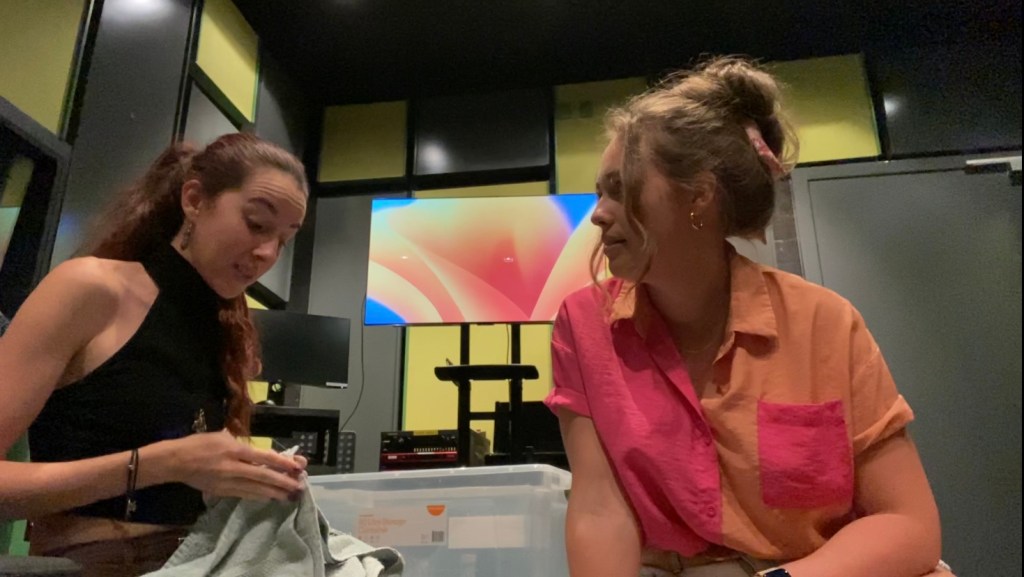
To continue these experiments with music written specifically for River Town People, the director, editor and I discussed writing temp music (music created for the editor to use as a mood filler or assist with the timing of cuts). This would allow me to test the synthesis of techniques before the film entered post production. Because the films’ edit was not yet complete, instead of having a spotting session, the director provided musical briefs for different emotions she wanted to target in the story. The two pieces I have used to present the experiments’ results are Lucy’s Theme and Water. Sharay Armfield ordered a hydrophone to record the music underwater, however it was broken on arrival. After hours of testing it and triple checking every setting we concluded that the plate in the microphone was damaged and therefore useless.
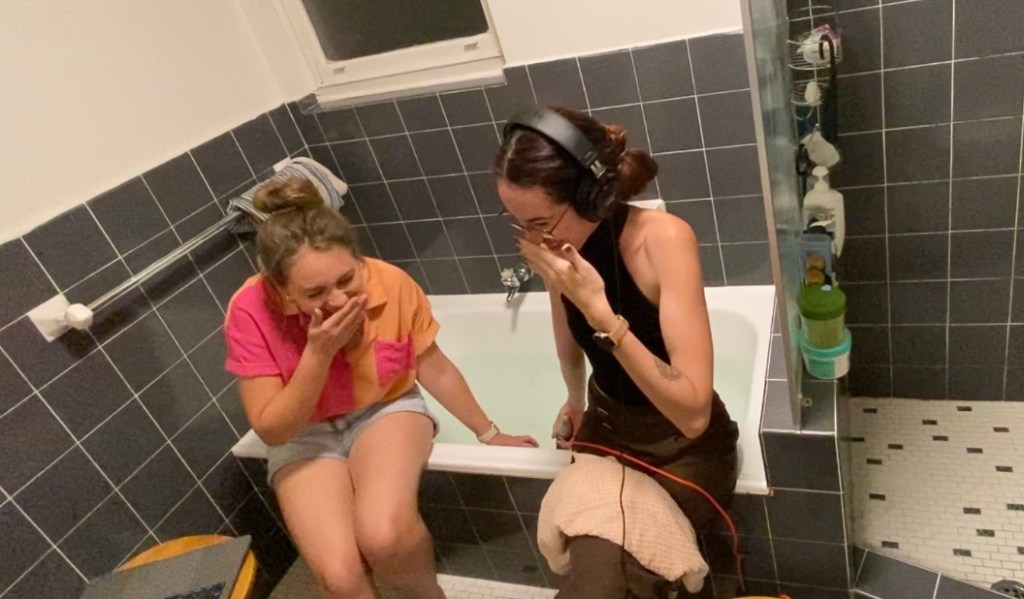
Figure 2: Sharay Armfield and Christina Bowden discussing broken hydrophone in Foley Studio at AFTRSFigure 3: Sharay Armfield and Christina Bowden laughing about potential solutions
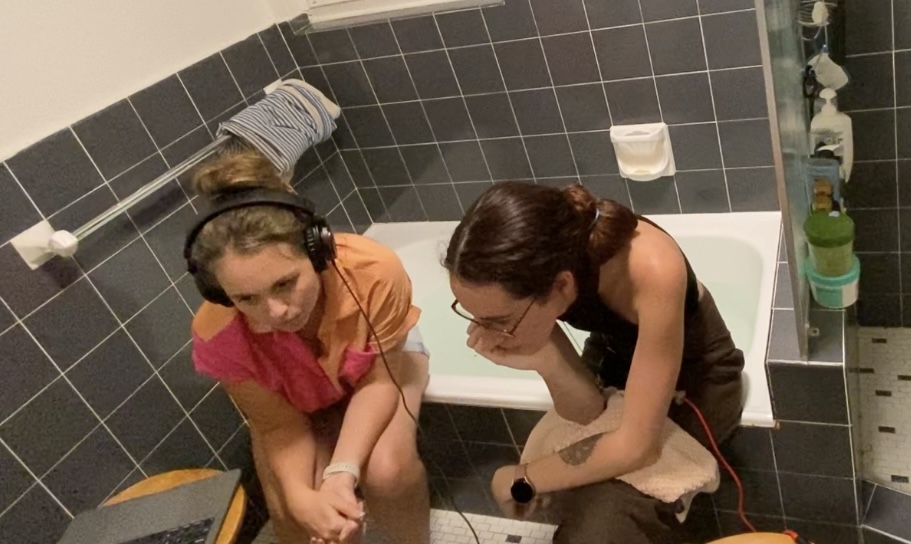
Determined to complete our experiments recording music underwater we recalled advice provided by sound design lecturer, Steve Murphy. He suggested placing a condom on a standard microphone and submerging it. This method has been used in a professional setting before and proven successful, so Sharay Armfield and myself decided to try it. Because of the tight deadline and limited use of the foley studio we moved our recording session to my bathtub. The bathroom was surprisingly sound proof and allowed us to record quality samples of music underwater.
Figure 4: Sharay Armfield and Christina Bowden recording music underwater with condom-wrapped microphone in bathtub
Lucy’s Theme
One of the briefs from the director requested a theme for the main participant, Lucy. After seeing a snippet of Lucy’s interview to get an idea of her natural tempo (shown in her speech and physical movement) I wrote a short piece that represented her strength, steadiness as well as emotional vulnerability. The instrumentation used for this piece was piano, cello & another world synth. When recorded underwater the lower frequencies of the cello and synth overpowered the piano and completely changed the dynamic of the piece. Here is a comparison of the original piece and the underwater recording (speaker fully submerged with microphone).
Lucy’s Theme – Original
Lucy’s Theme – Underwater Recording
Due to the overwhelming sound of the cello and synth, I decided to record each stem separately and mix them after. I tried multiple variations of mix combinations before I settled on mixing original cello and synth with piano recorded underwater. The piano recorded underwater by itself resulted in a beautifully smooth reverb effect that complimented the emotion of the piece.
Lucy’s Theme – Mixed
After completing these experiments with Lucy’s Theme, I presented the findings to the director, sound designer and editor. Asking them what differences they noticed between the 3 recordings, I received varied answers starting with Sharay Armfield providing a combination of narrative and technical feedback saying, ‘the piano is clearer in original, experiment 9 feels deeper and more solemn though experiment 10 did not feel as harsh on the top ends.’ Chimene Khoo expanded on this same point of experiment 10 being a mix of the two and potentially more affective to the narrative. ‘Experiment 10 seems to be the midpoint between original and experiment 9 – it’s not too dark/ominous, but still gives some weight to the primary emotions that come through (longing, sadness, hope and fight for survival).’ Director Michelle Kaldy’s feedback was very similar in that she preferred the outcome of experiment 10, highlighting how well it would fit the narrative. ‘Even though the original is clearer, the others definitely have a sense of droney-ness to the sound, kind of like a whale song and how it feels far away. To me this fits well with the story’ (2023).
Water
To further explore techniques of synthesising sound recording in music, I wrote a piece using manipulated water sounds as instrumentation. The process began with listening to each water sound provided by the sound designer to see if any held specific pitches or rhythms that worked within the style of the other pieces. The waterfall sound in particular stood out with a few precise percussive hits that could be manipulated to work within a more dramatic piece. The other water sounds had a pretty consistent natural flow that I could experiment with in pitch and tempo. The purpose of experimenting with water as an instrument was to create a sweet spot where the water would not sound exactly like water but still familiar enough to create the affect event in the narrative. If the water was manipulated too much, it risked sounding like the synths already used and losing its evocative power. This piece was the most affected by the underwater recording process. When submerged in the water, the water smoothed out certain rhythms and made the running water sound more like a cold wind and the waterfall percussive hit sound more like a delayed heartbeat.
Video of Sharay Armfield and Christina Bowden recording Water in bathtub with submerged speaker and microphone
Water – Original
Water – Underwater Recording
When the key collaborators submitted their feedback on the experiments of this particular piece, it was clear that they too thought the technique of recording music underwater had a substantial affect on the sound of the water. ‘It has more gravitas when it comes to introducing the solemnity and/or ominousness of the situation in the story arc and Lucy’s emotional arc’ (Khoo, 2023). This narrative based feedback indicated that this piece can potentially cause an affect event which will help communicate the emotions displayed in the story.
Employing Synthesised Techniques and Attaching to Picture
The final step of this research was to employ these synthesised techniques in film music and sound recording for affective meaning in screen storytelling and demonstrate how they work when synced to the film. To best demonstrate the techniques experimented with, Sharay Armfield and myself decided on a specific scene in the fine cut of River Town People where the opening title cards describe the devastation caused by the floods then cuts to Lucy standing on the beach looking reflectively at the water. In this scene, Lucy’s reflective and heavily emotional facial expressions open the door for music and sound to connect and help communicate what she is feeling. It is the perfect opportunity to combine sound recording into music using the experiments’ results.
The sound track for this scene begins with natural sounds of running water and beach waves then slowly transitions to the musically manipulated water sound in piece, Water, then into the underwater recording of Water, which finally transitions into Lucy’s Theme where the synth and cello begin the piece using a similar frequency range and timbre to the water which resulted in a subtle transition from sound to music. These combined techniques cause an affect event in the familiarity of the water sounds which then through slow and subtle manipulation, transfer to music which enhances the emotions of the scene. The synthesis of techniques in music and sound add an extra layer of context and a sense of being haunted by the floods, as articulated well by editor, Chimene Khoo,
The sound of waves at the start adds an extra layer of context to the title cards that are in there, like we’re hearing what happened and then seeing the devastation it caused in the cutaways. The initial waterfall crash SFX or the “heartbeat” sound when we see Lucy, and that leading to Lucy’s theme, helps introduce us to Lucy – who she is and how she’s feeling without it being too explicit. It’s like she’s being haunted by the floods, and she can still feel the impact of it, which is then where the primary emotions of Lucy’s theme (longing, sadness, hope, fight for survival etc.) take over once we start to see the ob doc part of the film.
(2023)
The director also recognised the heartbeat sound coming through the manipulated waterfall percussive hits, which she said ‘really helped build a sense of ominousness’ (Kaldy, 2023). Later in her feedback, Kaldy expanded on the affect this synthesis of techniques would have on the narrative. ‘I think visually it has the potential to set up the start of the film and the level of tension that will be seen throughout. The water is an underlying factor in the hopelessness that the community is feeling’ (Kaldy, 2023).
Clip from River Town People fine cut
Conclusion
In this exegesis I attempted a synthesis of techniques in film music and sound recording to enhance affective meaning in screen storytelling. After first establishing what roles music and sound recording play in the filmmaking process it was clear that there are a variety of techniques composers and sound designers can use to cause the affect event which in turn enhances the emotions of the story. The affect event is reliant on familiar sounds which evoke certain subconscious reactions before they are identified as emotions (Thompson, 2014). Therefore the techniques I experimented with were choice of instrumentation and recording environment. In each experiment it was important to use sounds with emotional importance and connection to the story; in a documentary centred on the catastrophic repercussions of flood water it was decided amongst key collaborators on the project that the element of water would hold the most evocative and emotional power in relation to the story. Including elemental sound design, such as the sound of running water, as instrumentation in my compositions caused the affect event through drawing on the waters’ evocative power and familiarity and connecting it to the emotional power of the music. This resulted in enhancing specific emotions being shown on screen and supported the storytelling.
In my experiments with recording environments, recording underwater was deemed the most appropriate environment for River Town People due to the emotional significance the water held in the story as well as the connection to the first experimental synthesis that used water as instrumentation. The sound designer and I conducted various experiments testing different instrument palettes (stylistically appropriate to the documentary) and equipment placements which, upon reflection and feedback from collaborators, resulted in a clear yet subtle synthesis of techniques which, as intended, enhanced the emotions of the story.
The final experiment was to combine these techniques and put them to picture. The opening sequence from the fine cut of River Town People provided the perfect setting for sound design and music to connect and enhance the emotions shown by the facial expressions of main participant, Lucy. The sound designer and I used both techniques of instrument choice and recording environments we experimented with to create a subtle shift from pure sound design to pure music. The success of the synthesis of techniques was based on the subjective points of view from the director, sound designer, editor, and composer. The combination of these four crafts provided diverse feedback and a convincing result of success. The results from each experiment was highly encouraging and each collaborator asked to provide feedback concluded through narrative and technical lenses that the synthesis of film music and sound recording techniques such as choice of instrumentation and recording environment held a compelling and powerful affect that can be used as tools to enhance affective meaning in screen storytelling.
In an ever growing industry, filmmaking is constantly evolving and improving, as creative practitioners it is the filmmakers job to evolve and improve alongside it. This research was designed to discover new techniques film composers and sound designers might use to continue growing in their crafts and improving their skills for the betterment of projects. As creative practice research, the experimental nature of this exegesis has improved my practice as a film composer by opening my eyes to certain techniques that can be used to better collaborate with other crafts such as sound design. Due to the success of this research, it is fair to conclude that the synthesis of techniques in music and sound recording can be used in future projects by myself and other practitioners. Although the results of this exegesis were successful and have concluded that these techniques can be synthesised for the betterment of projects, it leaves room for many future experiments. This might include experimentation with variations of equipment, instrument palettes or other sound elements, and definitely the synthesis of other composition and sound recording techniques used in filmmaking. The synthesis of techniques in film music and sound recording employed for affective meaning in screen storytelling for this exegesis was confirmed successful by featured collaborators on the project River Town People and opens the door for future experimentation between other practitioners on various projects.


 Christina Bowden